
The Ben-Anna Split
On Our Need to Become Ourselves Beyond the Mirror of the Other

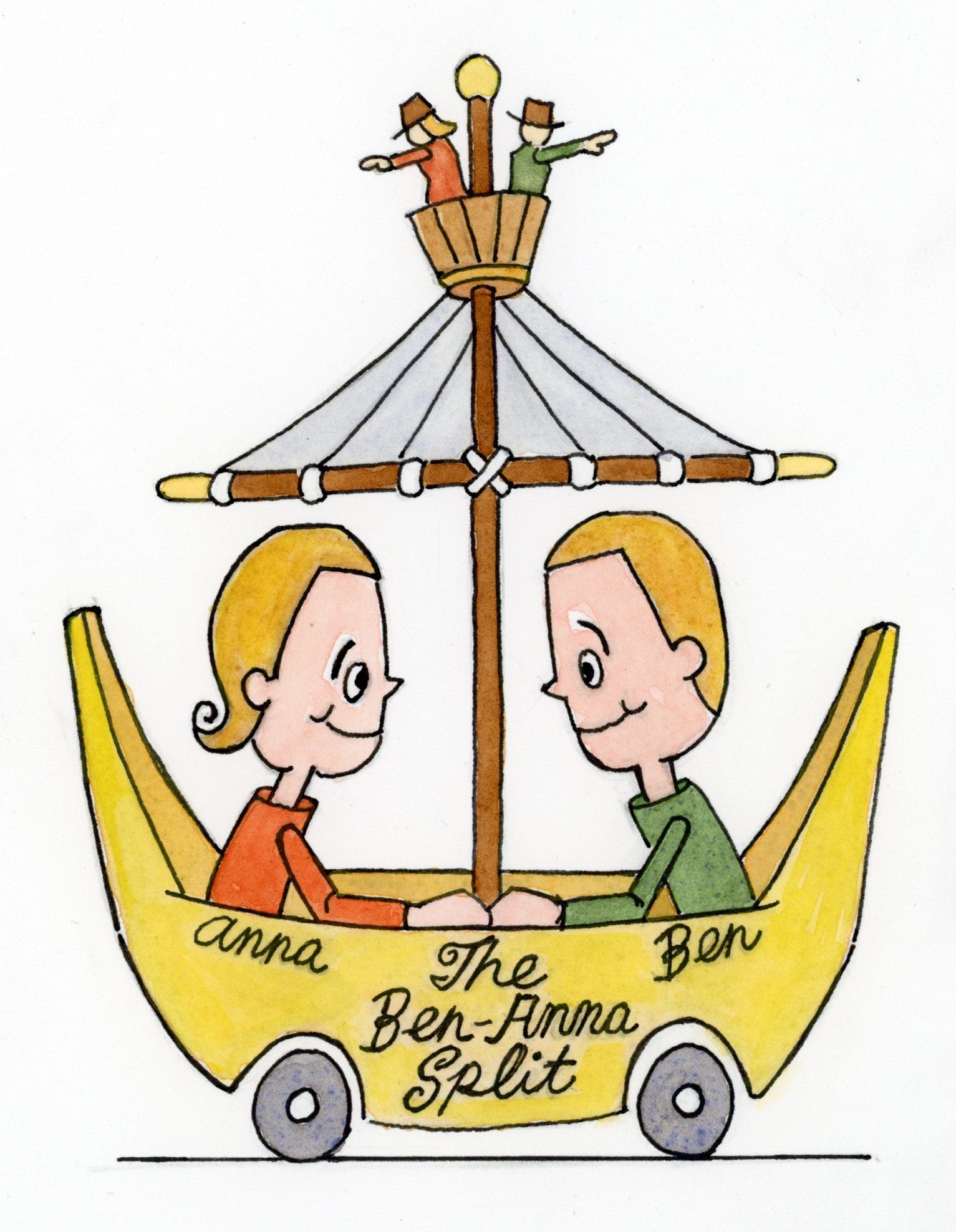
Every Saturday the parents wheeled them into the coffee shop directly into my line of sight: a boy and a girl—twins—looking about with the astonished eyes of yearlings.
“What are their names?” I asked.
“This is Ben,” their father said, formally introducing them, “and this is Anna.”
“Ben and Anna?” I asked.
“We wanted two names that together meant one thing: Ben-Anna—Banana.”
And that’s how they looked sitting in their wagon face-to-face: like two halves of a banana in the boat of a banana split, the head at one end echoing the head at the other.
Day after day, while waiting for their order, their parents parked the two clones in front of me. Naturally, the children and I exchanged curious glances, and I began the process of making friends.
Anna immediately smiled and seemed to find my efforts at communication—raising the pitch of my voice, mobilizing my eyebrows for extra expressivity—amusing. It was easy to win her over.
Ben was having none of it.
He looked at me with a mixture of fear, suspicion, and annoyance. “Who are you?” he seemed to say. “Go away.”
I knew exactly how he felt. I remember being a child. I remember adults poking their uninvited noses into my personal space.
To win over Ben I proceeded gingerly. I chatted with the parents—Ryan and Victoria—allowing both twins to size me up while I wasn’t paying attention.
But I was paying attention.
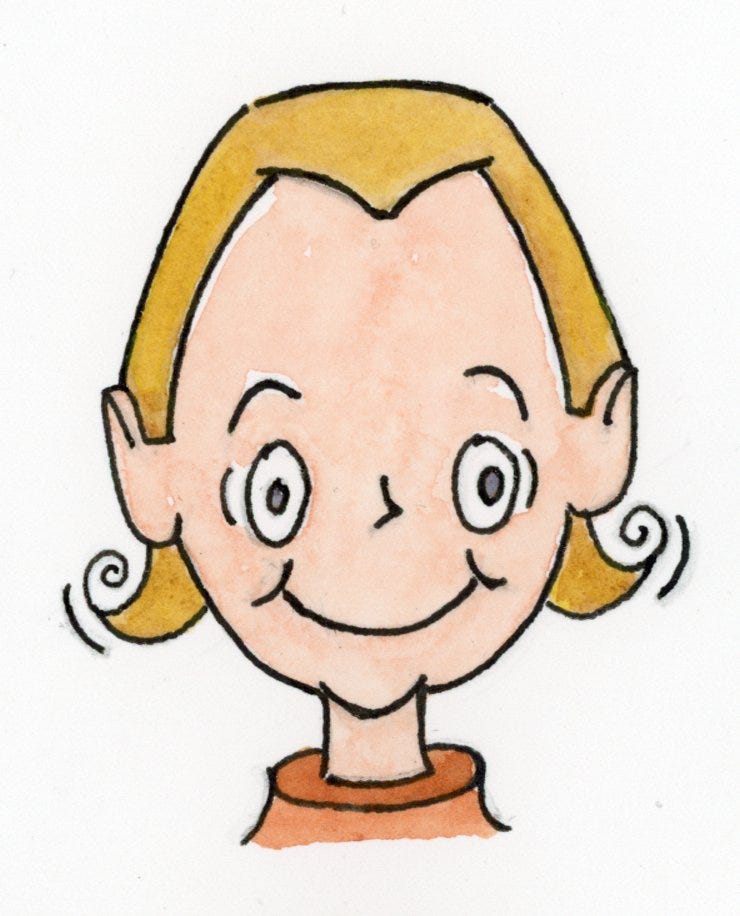
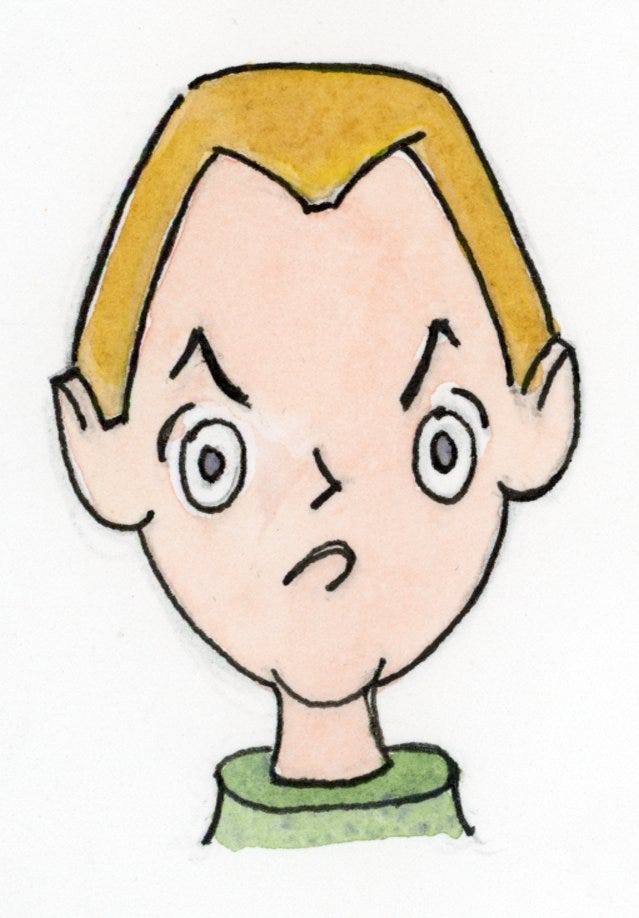
To Ben’s skeptical eye and Anna’s happy smile. To Ben’s frown that said I was not to be trusted, to Anna’s smile that argued I was safe. To Ben’s fearful feelings that I was an intruder, to Anna’s easy-going conclusion that I was a friend.
For a moment I saw their whole future turning on this difference—one pushing for the right to feel his way to the truth, the other pulling for the claims of her quick wit. The see-saw of the twins’ difference set me to thinking about how we define ourselves.
I found myself thinking, that is, about what we might call the Ben-Anna Split—the effort to define ourselves against others.
How could Ben and Anna—twins living in the same boat—NOT end up defining themselves against each other, whatever their innate leanings? Even non-twins do it; we all do it. Being twins could only make the impulse more pressing.
Difference, the linguists tell us, is the mechanism of meaning in language; we define words by their difference from other words. It’s the same with Self-definition. We become ourselves by saying we are NOT THAT!
But if a person is ever going to “come into his or her own,” as we say, sooner or later—it seems to me—that person has to move beyond the reactive—“NOT THAT”—and into a proactive—“YES THIS.”
In my experience, this is a tricky moment, requiring an uncomfortable turn into silence and solitude. Without the push of others, we suddenly find ourselves in a dead calm—sails empty, course uncertain.
I’ve spent so much time in reactive mode that the promptings of whatever genius I have are barely audible. Once alone, anxiety, or outright panic—the fear of the freedom—sets in.
At this point—again, in my experience—the urge is usually to bolt to the safer ground of some conformity—to the church, to the party, to the job, to the mall, to the devil himself if need be.
To any group that offers me a role, a belief, a purpose—a pseudo-self mimicking the undiscovered real one.
It’s so easy to lose one’s self—and it’s inconspicuous too. As Kierkegaard, in his inimitable, black-comic way, put it:
The greatest hazard of all, losing one's self, can occur very quietly in the world, as if it were nothing at all. No other loss can occur so quietly; any other loss—an arm, a leg, five dollars, a wife, etc.—is sure to be noticed.
It will be a long while before such questions become meaningful for Ben and Anna.
Right now, they are hardly individuals, so absorbed are they in their relationship to their parents and to the world. But we adults know the road they’re on—the one that leaves childhood and carries us all into ourselves.
However powerful our nostalgia for childhood, we can’t go home again. Once the doctor cuts the umbilical, we’re pushed into the quest for independence.
One Saturday morning at the coffee shop, Ben took a funny little baby step in that direction, a step which also marked a small victory in my campaign to win him over.
I had been slowly, patiently, deliberately softening him up, trying to make friends. Slowly he began to laugh and smile at my antics, but still, he kept his distance.
Then, one morning, as I was ordering my sugar-free vanilla latte, Ben and Anna burst into the coffee shop with crazy joy.
“Chris!” they yelled, and before Ben realized exactly what he was doing, he had jumped.
He was in my arms. But his enthusiasm had outrun his good judgment. His guard had fallen as he jumped, but it came abruptly back up as he landed.
Luckily, I saw in his eyes the fear of his own reckless affection, and I immediately set him down—before his brain could register a need to scream.
“He’s never done that before!” Ryan said.
His parents congratulated him for the impulsive act he had already disavowed, and then he was congratulating himself in confusion.
It’s a long day’s journey into oneself.
But what a beautiful, double-ribboned course seems to be set for Ben and Anna! How lucky for a boy to be able to search for himself through the eyes of his twin sister and a girl to be able to find herself against the eyes of her twin brother!
I see them floating into the future in the yellow boat of their Banana Split, riding the waves of the Big Blue, searching like all of us for their reflections in the water. Some day they’ll find it: that place where Sea mirrors Sky and says, in the secret language of all our mirrors—“I know you!”
…that’s some good naming on the parent’s side…so funny…it is interesting to feel so drawn to solitude but so necessarily in need of others for so many aspects of self…ever seen alone in the wilderness?…i think about that doc all the time and that dude living on his own for so long…it feels so romantic…but it feels that way because there is a documentary and I have seen it…even in glorified solitude there is benefit to others bearing witness…
I'm working on something called "Sydney Sweeney's Gaze," because that look, the disarming skeptic, you might say, seems both necessary and symbolic of our times. I wonder to what extent Ben's reticence is in relation to Anns's enthusiasm. Not exactly caused by it, but competitively or protectively. I hope you get to watch them develop together.